
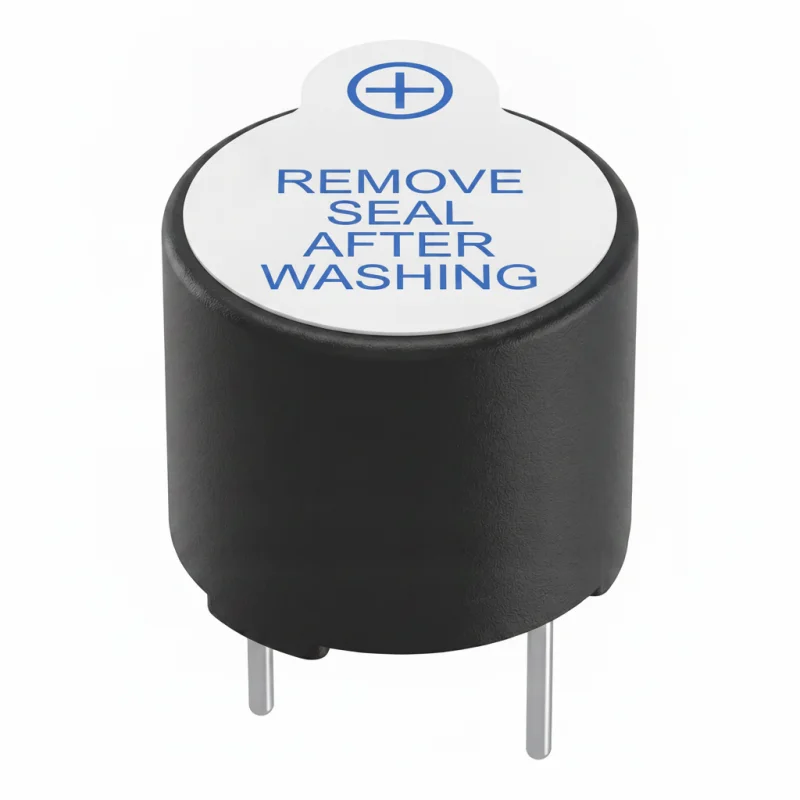
Description
The TMB-12A05 active buzzer is an electronic sound signaling component designed for simple acoustic alerts in low-voltage circuits. Thanks to its integrated tone generator, it is controlled by direct current (DC) voltage and does not require separate driving by an external frequency.
Technical Specifications
Type: TMB-12A05
Design: Active buzzer
Operating voltage: 4 to 7 V DC
Rated voltage: 5 V DC
Maximum current: 30 mA
Frequency: 2300 ± 300 Hz
Sound level: 85 dB at a distance of 10 cm
Operating temperature: -20 to 70 °C
Dimensions: 12 x 9.5 mm
Mounting: Through-hole design for PCB mounting
Polarity: Marked positive pole on the casing
Features and Characteristics
Active design with an integrated acoustic signal source.
Generates a tone upon applying DC power within the specified range.
Two-pin design allows direct connection into an electronic circuit.
Compact cylindrical casing suitable for printed circuit board (PCB) mounting.
Polarity marking facilitates correct wiring in the circuit.
Ideal For
Acoustic signaling in electronic projects.
Development and prototyping boards.
Signaling device statuses, alarms, or alerts in low-voltage circuits.
Integration into custom electronic builds with a power supply range of 4 to 7 V DC.
Package Contents
1 x TMB-12A05 active buzzer
Why Choose This Product
Does not require an external tone generator as it operates as an active buzzer.
Features clearly specified electrical and acoustic parameters for circuit design.
Through-hole design is suitable for soldering onto a PCB.
Operating voltage range of 4 to 7 V DC matches common low-voltage electronic applications.
Installation and Operation Instructions
Observe the marked polarity of the component during wiring.
Power only with DC voltage in the range of 4 to 7 V DC.
Verify the pin layout on the PCB before soldering.
When driving from a microcontroller, ensure the output pin or switching element can handle the buzzer’s current draw.
Safety Warnings
Do not exceed the specified operating voltage and maximum current.
Incorrect polarity, short circuits, or overvoltage may damage the component or the connected circuit.
Perform assembly and soldering with the power disconnected.
The component is designed for low-voltage electronic circuits, not for direct connection to mains voltage.
Reviews
There are no reviews yet.